
American conceptual/pop artistBarbara Kruger is internationally renowned for her signature black, white and red poster-style works of art that convey in-your-face messages on women's rights and issues of power. Coming out of the magazine publishing industry, Kruger knows precisely how to capture the viewer's attention with her bold and witty photomurals displayed on billboards, bus stops and public transportation as well as in major museums and galleries wordwide. She has edited books on cultural theory, including Remaking History for the Dia Foundation, and has published articles in the New York Times, Artforum, and other periodicals. Monographs on her work include Love for Sale, We Won't Play Nature to Your Culture and others. She is represented in New York by Mary Boone Gallery. A major exhibition of her work will be presented at the Museum of Contemporary Art in Los Angeles in fall 1999, and at the Whitney Museum in New York in 2000.
Research Kruger's work to find an example from the 1970s or 1980s to compare with a more recent work. How has Kruger's work changed with the developments in contemporary visual arts? Describe a recent work that moves away from the 'poster' type work of her early career.
Barbara Krugers artwork is really quite bold and powerful. It grabs your attention and almost slaps you across the face with its bold messages. One that really caught my eye was 'We don't need another hero'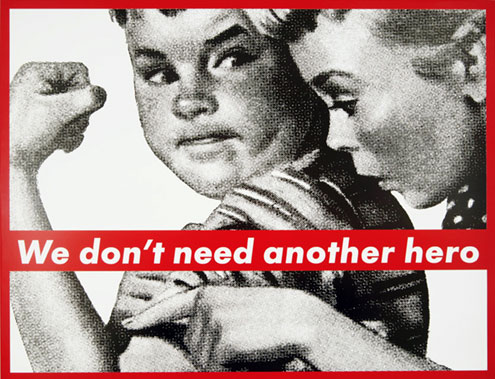
To me, the work speaks about how everyone grows up with grand dreams of some kind, but no one really achieves them, often because they are impossible. I wanted to grow up to be a transformer, but despite my best efforts I can still only turn one of my hands into a side mirror, and what use is that really. It also looks as if the boy is trying to show how tough he is to the girl, playing on sexual stereotypes about how men are stronger and women need them to look after them.
This new work of Krugers also caught my eye, "Untitled/Chess Board"
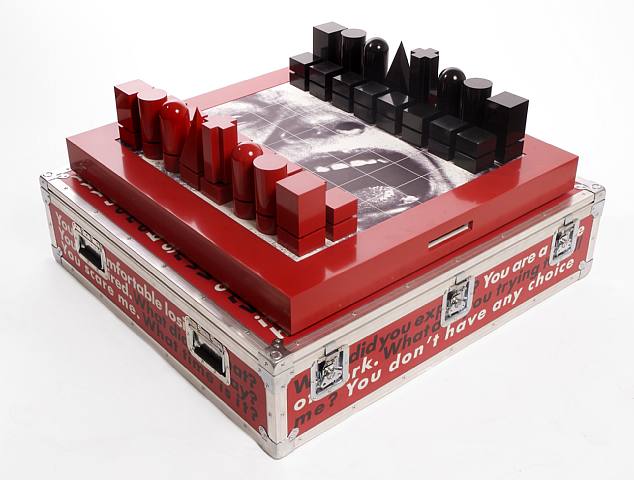
It shows her progression from flat 2d posters to something more 3d and contemporary art like, incorporating scultpure while still maintaining her bold black white and red distinctive style. The work speaks to me about how we're all just pawns in some grandscheme of the rich and powerful, almost tieing in to the whole illuminati grand scheme conspiracy theory, with the phrase "you have no choice" particularly catching my eye, as if to say "you're already someones pawn, and you're stuck in it, in this society, you cant change, you cant get out, you have no choice".
Find 2-3 works by Kruger to add to your blog.
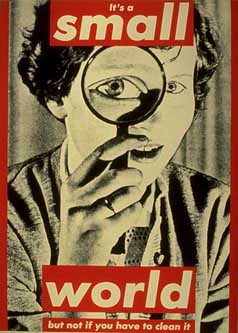
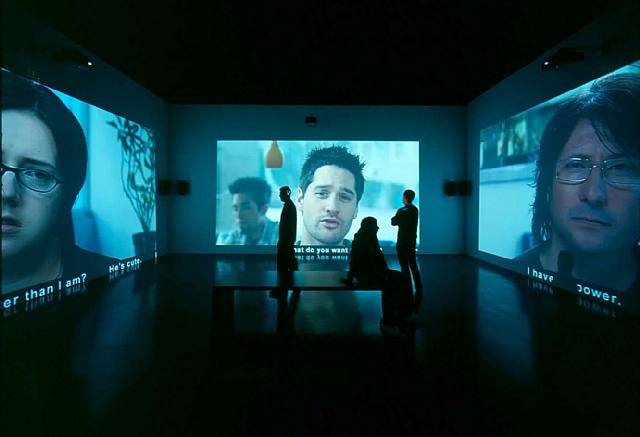
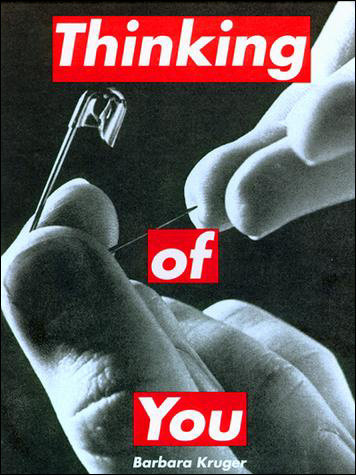
How does the audience experience a more spatial, installation art work compared with a poster?
I think the audience experiences a spatial or installation art work differently from a poster in that the audience becomes part of the work. When you stand and look at a poster, its nice to look at, but thats just it, you just look at it. Something spatial that you can move and walk through, or even interact with, engages the audience more and helps convey the artists meaning.
What elements does Kruger use in her work to create a strong impact?
What elements does Kruger use in her work to create a strong impact?
Contrasting black and white images with bold red and white lettering. Quite stattic almost serene photography that often seems to contrast with the text also seems to be an apparent element, where the picture by itself might seem somewhat harmless and fine, as soon as you combine it with the text it becomes something completely different, and the meaning changes, which I think is her strongest element.
Comment on the development of her work over the last 30 years.
Comment on the development of her work over the last 30 years.
It's quite impressive the way her work has changed and yet not changed. Her work has progressed from simple posters into full spatial installations with video and audio, but her distinctive style is still there, showing you it is definately a Kruger work. Personally I think the fact she has stuck with such a distinctive style all this way is impressive, others might call it lazy, but I think theres a fineline between not improving and not fixing what isnt broke.
Comment on the examples that you find on other students blogs.
Comment on the examples that you find on other students blogs.
sunday, august 22, 2010
Images courtesy of http://www.arthistoryarchive.com/arthistory/feminist/Barbara-Kruger.html


